

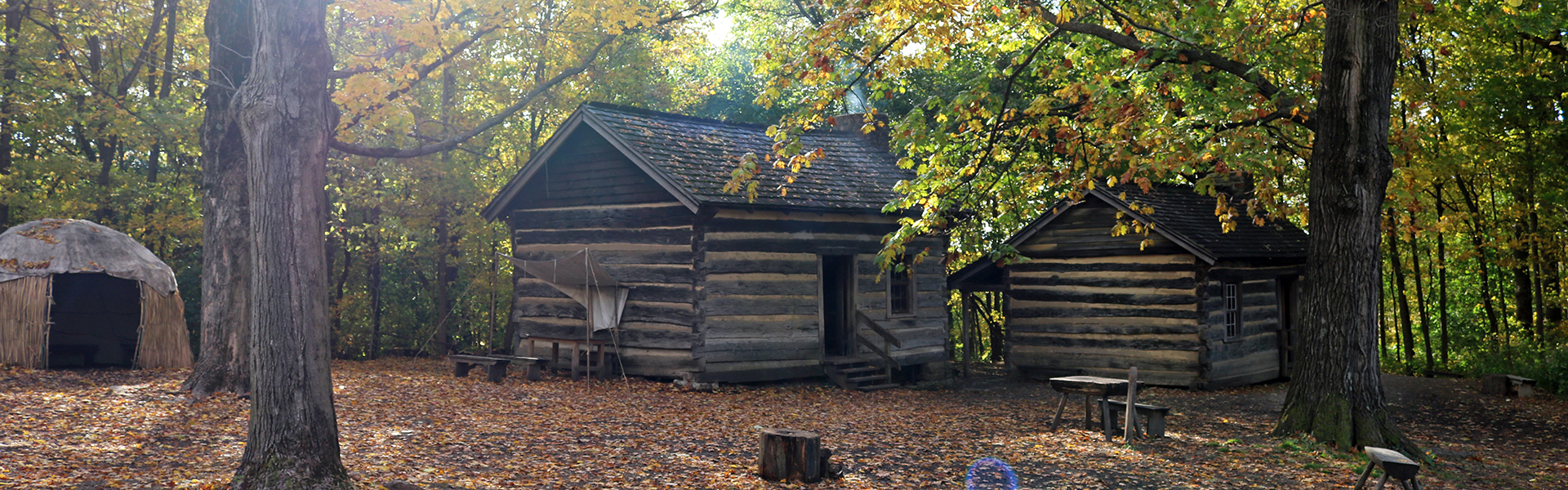
Welcome to Lenape Camp
Step into Indiana territory in our earliest historical area, Lenape Camp. Here you will explore the life, culture and relationship between the Lenape Indians and American fur traders. On the cusp of statehood, life is changing for those who live here. The impact of Indiana's transition from territory to statehood is felt in the economy, the environment, and the people posing the question, "Would you be willing to adapt in order to survive?"
Activities
- Learn a Frontier Skill
- Wilderness Travels
- Make a Trade
- Meet the Locals
- It's Game Time
-
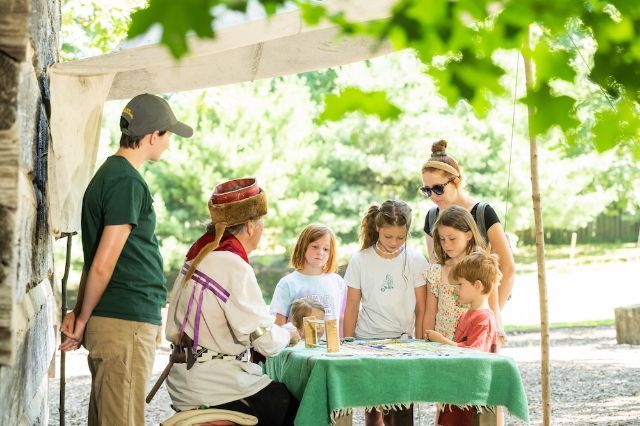
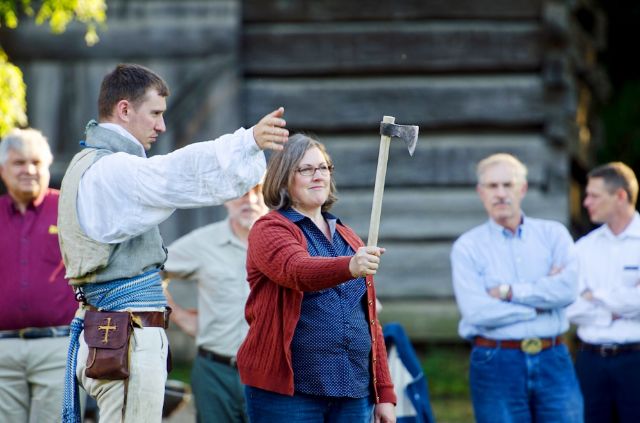
Put your hands to the test as you learn to throw a tomahawk, make baskets and pottery, tan hides, or fire a flintlock rifle.
-
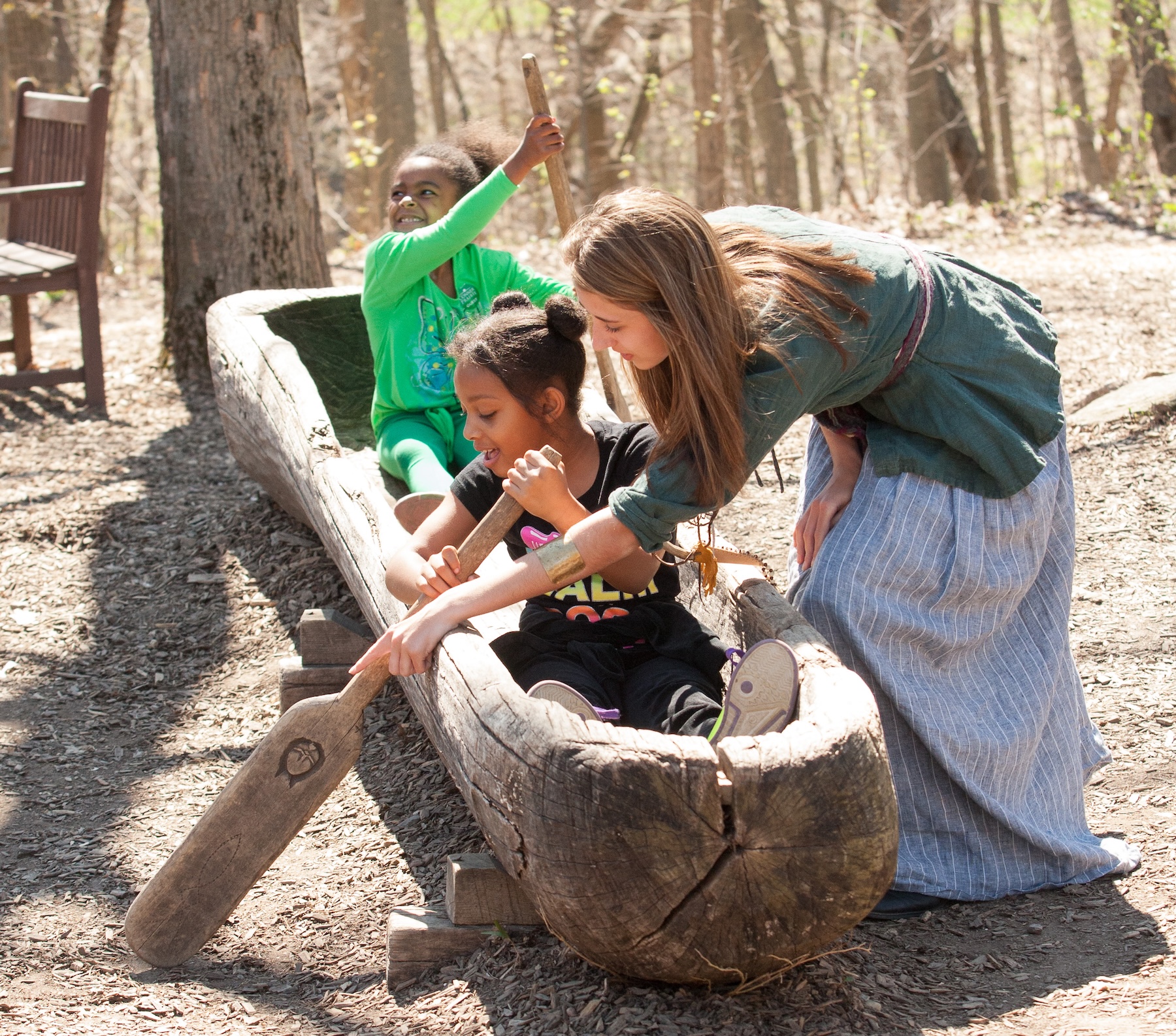
Climb into an authentic dugout canoe and get a sense of what it was like for the Lenape and fur traders to transport goods.
-
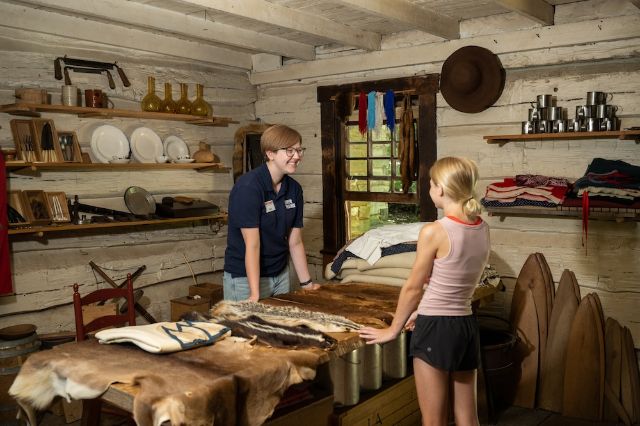
Stop by the Trading Post and see what supplies you need or fancy goods you may want. How well can you negotiate a deal with the Trader?
-
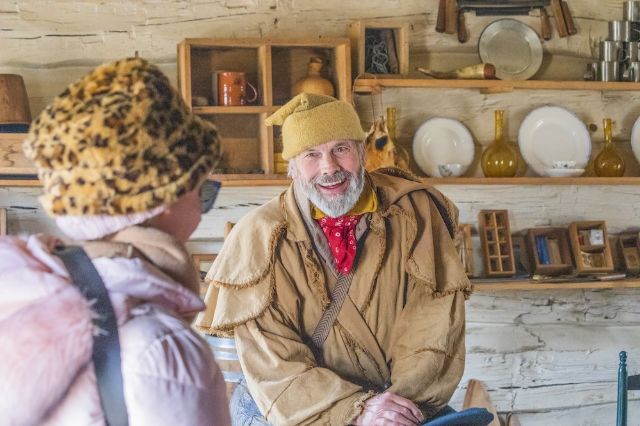
Learn about Lenape life firsthand from one of our interpreters.
-
No electronics or internet here; play games that require only your hands and your brain.
History of the People and Place
Additional reading and deeper information.
Captain John Conner.
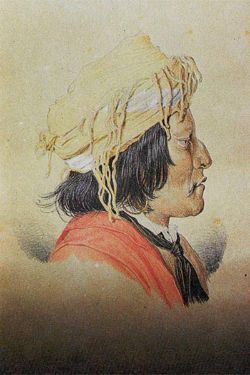 Sometimes in the life of the individual can be seen the lives of the family or the nation; echoes of the whole may reverberate through the one. Such was the case, in many ways, of the life of Captain John Conner. Like his nation, the Delaware (Lenape), his life became an amalgamation of leave-takings and new frontiers; like his family, the Conner pioneers of the Old Northwest, his life was that of one warily caught between two cultures, a mediator of sort, who eventually stepped fully into one camp.
Conner's life was varied, exciting, and played out across much of the American west. So well regarded was Conner that famed frontiersman Richard Dodge wrote that he was "renowned as having a more minute and extensive knowledge of the North American Continent" than anyone in America. In some ways his life was a mini-series waiting to be filmed.
John Conner was born in 1802 near a bend in the White River in present-day Hamilton County, Indiana. He was the first child of William Conner, pioneer trader, and Mekinges, a Delaware woman. Both were relative newcomers to the new territory of Indiana. William Conner came to Indiana in 1800-1801 as a trader. Mekinges was likely living among the first groups of Delaware who arrived after 1795. It may have been her initial migration to a new homeland, but not hers or her people's last.
Almost nothing is known of John Conner's early life. He grew up along the banks of the White River, the oldest of William and Mekinges' six children. As central Indiana had few white settlers, his companions were mainly the Delaware, Miami, and Shawnee who moved through the area. Undoubtedly, he was schooled in the lifeways of his people. That he was skilled at living from the land and making it his own is evident from his later life.
The earliest turning point in his life was shared with the Delaware – their removal west in 1820. Among the provisions of the Treaty of St. Mary's in 1818 — a treaty facilitated by William Conner — was one stipulating the removal of the Delaware, in order to open central Indiana to white settlement. Mekinges, John Conner, and his five siblings left Indiana for lands in Missouri in 1820; as is well known, William Conner stayed behind on their land to await white settlement.
After a harrowing journey that saw them harassed by whites and many of their goods stolen, the Delaware made it to Kaskaskia, Illinois. It was there that John Conner's path diverged from the Delaware. While their hegira was to take them to Missouri, then Kansas, and finally to Oklahoma, John Conner set out on his own. It was the beginning of nearly four decades of wandering.
Later recounting the incident, Conner said he was stirred by a "most intense desire" to see an ocean. He knew there were two oceans. Since going east meant traveling through the white man's country, he headed west.
Traveling mainly on foot and alone, although he probably joined up with a trading or trapping party occasionally, he made his way to the Columbia River in the Pacific Northwest. Then turning south, he trekked along the Pacific coast in present day California. Eventually, he made his way into Mexico. Liking the residents of Durango, he lived with them for three years, learning their language and customs. Like his father, he seems to have had a talent for languages and was known for his fluency in many dialects. However, he never learned to read and write. Conner grew weary of city life and decided to return to his people around 1824. On his way through Texas, he encountered a splinter group of Delaware living there.
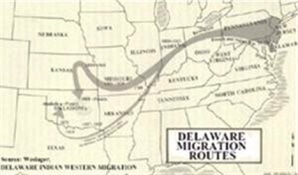
Some of the Delaware were part of a band which had accepted an invitation from the Spanish to settle in modern Texas and Arkansas in the 1790s. The Spanish, fearing American settlers, invited various Indian nations to settle and act as a buffer against encroaching whites. Yet another band of Delaware had split off and migrated to the area in 1819. Together they eventually became known as the Absentee Delaware, and John Conner quickly made contact with them.
John Conner was to spend much of his life among this group and others in Texas. Like his father, William, he was to act as representative, interpreter, and peacemaker between the red and white worlds.
He eventually worked for the government of Texas acting as translator and negotiator on treaty and peace missions. His good work was cited by Sam Houston and other prominent Texans. His services were so valued that the state of Texas voted him a league of land, voting privileges, and made him a full citizen of the state, an unusual honor for a Native American. There was some question as to whether the land was meant only for Captain John Conner (the honorific was bestowed around this time) or a group of Delaware as a whole. Eventually, it was decided (to the chagrin of some Delaware) that Conner owned the land.
Not everyone appreciated the roles played by Conner. After a Delaware/Comanche clash along the Red River, Indian agent J.R. Baylor reported that a Comanche party was headed toward the Brazos Agency with orders to kill Capt. John Conner and others.
Many, though, thought highly of him. Cavalry officer Col. William Parker, who was long acquainted with Conner, viewed him, with a glimpse of the everyday racism of the period, as "differing from the generality of Indians." Conner, he wrote, "would give a direct answer" to questions and take a stand on an issue and support it with argument. He described him as very intelligent and a man of ingenuity.
Suggested Reading
Hale, Duane Kendall. Peacemakers on the Frontier. Anadarko, OK. 1987
Macy, Randolph B. Thirty Years of Army Life on the Border. Philadelphia, 1868.
Parker, W.B. Notes Taken During the Expedition Commanded by Capt. R.B. Macy, USA
Through Texas in the Summer and Fall of 1854. Philadelphia, 1856.
Weslager, C.A. The Delaware Indians: A History
Primary Sources
Richard C. Adams Collection, Kansas Collection, University of Kansas
Pratt Papers, Kansas Historical Society
Illustrations
Photo courtesy of the Bartlesville (OK) Public Library
Map appears in C. S. Weslager, The Delaware Indian Westward Migration (Wallingford, Pa, 1978)
Visit the official website Delaware (Lenape)
For over half a century the Conner family played an important role in treaty making and the removal of Native Americans. Between 1804 and 1866 William Conner, his brothers, and sons were involved in over 30 treaties (out of a total of 367 signed and ratified from 1778 to 1868) between the United States and Native Americans.
| Date | Tribe/Location | Signer |
|---|---|---|
| August 21, 1805 | Delaware, Potawatomie, etc. (Grouseland, Indiana Terr.) | John Conner* |
| September 30, 1809 | Delaware, Potawatomie, etc. (Ft. Wayne, Indiana Terr.) | John Conner* |
| July 22, 1814 | Wyandot, Delaware, Shawnee (Greenville, Ohio) | John Conner* |
| September 29, 1817 | Wyandot, Seneca, Delaware (Rapids of the Miami) | William Conner |
| September 17, 1818 | Wyandot, Seneca, etc. (St. Mary's, Ohio) | John Conner* |
| September 20, 1818 | Wyandots (St. Mary's Ohio) | John Conner* |
| October 2, 1818 | Wea (St. Mary's, Ohio) | John Conner* |
| October 2, 1818 | Potawatomie (St. Mary's, Ohio) | William Conner & John Conner* |
| October 3, 1818 | Delaware (St. Mary's, Ohio) | William Conner & John Conner* |
| October 6, 1818 | Miami (St. Mary's, Ohio) | William Conner & John Conner* |
| August 29, 1821 | Ottawa, Chippewa, etc (Chicago) | Henry Conner* |
| August 5, 1826 | Chippewa (Fond Du Lac, Mich. Terr.) | Henry Conner* |
| October 16, 1826 | Potowatomi (Mississinewa, Id.) | Henry Conner, James Conner & William Conner* |
| October 23, 1826 | Miami (Mississinewa, Id.) | William Conner |
| August 11, 1829 | Chippewa, Menomonie, Winnebago (Fox River, Mich. Terr.) | Henry Conner* |
| September 24, 1829 | Delaware (White River, Mo.) | James Conner** |
| August 30, 1831 | Ottowa (Miami Bay, Lake Erie) | Henry Conner* |
| October 20, 1832 | Potawatomie (Camp Tippecanoe, Ind) | William Conner & James Conner* |
| September 26, 1833 | Chippewa, Ottawa, Potawatomie (Chicago) | James Conner* |
| September 26, 1833 | Supplement to above treaty | James Conner* |
| September 26, 1833 | Supplement to above treaty | James Conner* |
| September 26, 1833 | Supplement to above treaty | James Conner* |
| September 26, 1833 | Supplement to above treaty | James Conner* |
| January 14, 1837 | Chippewa (Detroit) | Henry Conner* |
| December 20, 1837 | Chippewa (Flint River, Mich) | Henry Conner* |
| February 7, 1839 | Chippewa (Saginaw, Mich) | Henry Conner* |
| May 15, 1846 | Comanche (Council Springs, Tex) | Capt. John Conner*** |
| May 6, 1854 | Delaware (Washington DC) | James Conner*** |
| May 30, 1860 | Delaware Capt. (Sarcoxieville, Kan) | Capt. John Conner & James Conner*** |
| July 2, 1861 | Delaware (Leavenworth City, Kan) | Capt. John Conner & James Conner |
| July 4, 1866 | Delaware (Delaware Agency, Kan) | Capt. John Conner & James Conner |
The life of Mekinges, like that of most Native American women, is lost in the shrouding mists of a disinterested history.
If Euro-American women lived out their lives in the background, then it can be said that Native American and African American women existed on the deep-shadowed fringe of society. This is true in the case of Mekinges (probably pronounced Ma cun chis), Delaware woman and wife of William Conner. Even though she was the wife of an important trader and mother of two chiefs of the Delaware nation, little is known of her life.
Whether Mekinges' decision to remove west with the Delaware was a willing on her part or forced upon her is unknown. It would only have been natural for her to wish to remain with her people, but also to keep her family together. Initially she expected her husband to move with their family and was disheartened when he chose to remain in Indiana.
Mekinges followed the Delaware through their many moves. She lived in Missouri and Kansas. What is known of her life comes to us through bare-boned legal records and documents. Studying her life is made even more difficult because she appears to have been known by many different names, such as Mekinges, Elizabeth Ketchum or Mrs. Conner. She was listed on the 1842 census of the Delaware living in Kansas as the head of a household containing eight people. The date of her death is uncertain. Though some sources claim she died by 1861, as Ma cun chis, she may be found on the 1862 census and had a twenty-year old female living with her.
The "Other" Children
Because they were both chiefs and widely traveled, John and James Conner are the most well-known of the Delaware children. Unfortunately, little has come to light about their siblings.
Nancy Conner
The youngest of the daughters was born in 1815 and died in 1834. She married a Delaware named John Quincy Adams and had one daughter, Mary Adams. Nancy's grandson was one of the most famous of the later Delaware. Richard C. Adams was a leader and tribal historian who spent much of his life studying the past of the Delaware and working to better conditions of the tribe.
Eliza Conner
The eldest daughter, lived from 1812 to 1876. She spent most of her time with the main group but may have lived with her brother John and the Absentee Delaware on the Brazos Reserve in Texas in the 1850s. She returned to the main band in Kansas with her brother John and eventually died in Oklahoma.
Hamilton
(Also called Harry and Howard) Conner was probably born in 1805. Almost nothing is known of him. He was a signer of the 1823 petition and the 1863 lawsuit which sought to reclaim the Conner Prairie land. He appears to have stayed with the main group of the Delaware throughout his life.
William (Bill) Conner [Jr.]
Like his brothers, he was a guide and interpreter. He lived with the Absentee Delaware group in Texas and was employed as guide and interpreter for the Texas government. He was noted for his role in the freeing (via paying of a ransom) of a white child being held by Indians.
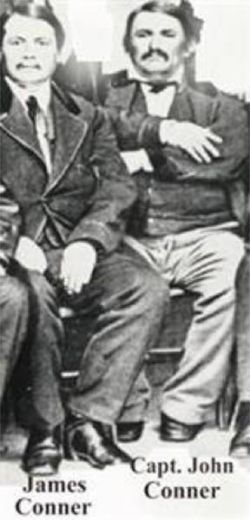
Capt. John Conner
The oldest of William and Mekinges Conner’s six children, John Conner (born ca. 1802) lived a life of high adventure. He joined his family and other Delaware on their removal from Indiana. The trek was a difficult one. Even before reaching the Mississippi River the Delaware were swindled or robbed of much their goods (Indian Agent William Clark, of Lewis & Clark fame, arranged payment to ferry the tribe across to Missouri). It was at this point that John Conner broke away from the family and began a life that to modern eyes seems to be the stuff of which adventure novels or TV miniseries are made. His life was varied, exciting, and played out across much of the American west. So well regarded was he that famed frontiersman Richard Dodge wrote that John Conner was "renowned as having a more minute and extensive knowledge of the North American Continent" than anyone in America.
Conner (later known as Capt. John for his service as a military scout) was stirred by a "most intense desire" to see an ocean. He knew there were two oceans. Since going east meant travelling through “white man's country,” he headed west. He made his way to the Columbia River in the Pacific Northwest. Turning south, he trekked along the Pacific coast, eventually making his way into Mexico. Liking the residents of Durango, he lived with them for three years, learning their language. Like his father, he had a talent for languages and was known for his fluency in the many dialects picked up in his travels. These skills were to help shape his life.
Deciding to return to his people around 1825, Conner was en route to Missouri when he encountered a group of Delaware who had moved to Texas decades earlier. Though he would make occasional visits to Mekinges and his siblings, it was among these Texas Delaware that Capt. John was to spend the next thirty years and make his reputation. Like his father, William, he was to act as representative, interpreter, scout, and liaison between the “red and white worlds.”
John eventually worked for the Texas and US governments, acting as translator and negotiator on treaty and peace missions. His good work was cited by Sam Houston. The state of Texas valued him so highly it made him a full citizen, an unusual honor for a Native American. A cavalry officer viewed him (in a chilling example of the everyday racism of the period) as "differing from the generality of Indians." Conner, he wrote, "would give a direct answer" to questions, take a stand on an issue, and support it with argument. He described him as very intelligent and a man of ingenuity. Physically, he was described in the 1840s as a "fine, portly man, about forty-five years old, and of very light complexion, with long, black hair and moustache."
The wanderer did not settle down until he returned to Kansas 1858 (the Delaware were removed to Kansas in 1830-31) upon being appointed Principal Chief of the Delaware. Why a man absent from the main group for nearly forty years was named chief is uncertain. Certainly, Conner's Delaware bloodlines and his reputation were important factors. There is a reason to believe that, because of his previous service, John was a very acceptable choice to U.S. governmental authorities. A rival for the chieftaincy later claimed John was appointed because he was a pawn of the government who would do as bidden, a so-called “Government Chief.” Conner upset many Delaware when he signed the 1866 treaty that once again removed the tribe, this time to Oklahoma. The date of John Conner's death is the subject of minor controversy, but he likely died in late 1872. One thing not in doubt is that an American life that began along the verdant White River in Indiana, was lived out across the sprawl of the American west, ended in the "green country" of Oklahoma.
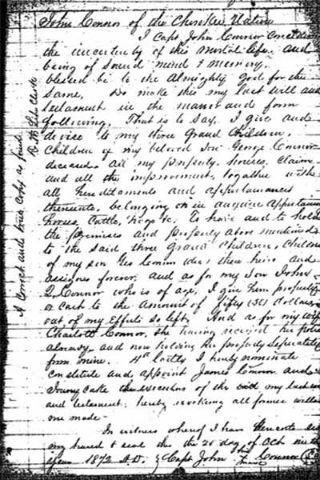 I Capt. John Conner coinciding the uncertainty of this mortal life. And being of sound mind & memory blessed be the almighty for the same do make this my last will and testament in the manner and form of the following, that is to say, I give and devise to my three grandchildren, children of my beloved son George Conner, deceased, all my property, houses, claim and all improvements, together with all herediments and appurtments, thereunto belong on ….. appertanancy, horses, cattle, hogs & etc to have and to hold the premises and property above mentioned to the said three grandchildren of my son Geo Conner (dec) their heirs and assignees forever; and for my son John Q. Conner who is of age I give him property or cash to the amount of fifty (50) dollars, out of the effects I have left. And as for my wife Charlott Conner, she having received her portion already – and now holding her property separately from mine, and lastly, I hereby nominate constitute and appoint James Conner and Jonas [?] Journeycake the executors of this my last will and testament; herby revoking all former wills by me made.
James Conner
Probably born around 1818, James was the youngest of the Conner children. Like his oldest brother, John, James Conner was touched with a sense of wanderlust. The Delaware were renowned for their abilities as guides and took part in many of the famous exploratory expeditions in American history. The great explorer and seeker of empire, John Charles Fremont, was greatly impressed by their abilities. James Conner accompanied Fremont on several of his expeditions, including the fateful expedition to California in the 1840s during which war broke out with Mexico and Conner was one of those who "enlisted" in the Fremont army. It was Fremont's habit to name natural phenomena after members of his expeditions as a means of rewarding good performance. Thus, there is a "Connor's Spring" near the Humboldt River in California that was likely named after James.
In 1858, James was nominated to be the principal Chief of the Delaware. However, he turned down the honor, saying his brother John would be more acceptable to other Delaware. Why his brother, who had spent most of the previous thirty-eight years away from the main band of the tribe, was more acceptable is uncertain. Some evidence indicates that James was involved in some sort of scandal. His brother was indeed named principal chief, but James continued as a lesser chief and later served as principal chief from 1873 until his death in 1877.